
10/27/2026 · By Luis F. Laguado
How to Get Cheap Truck Insurance and Keep Your Renewal Premium Low
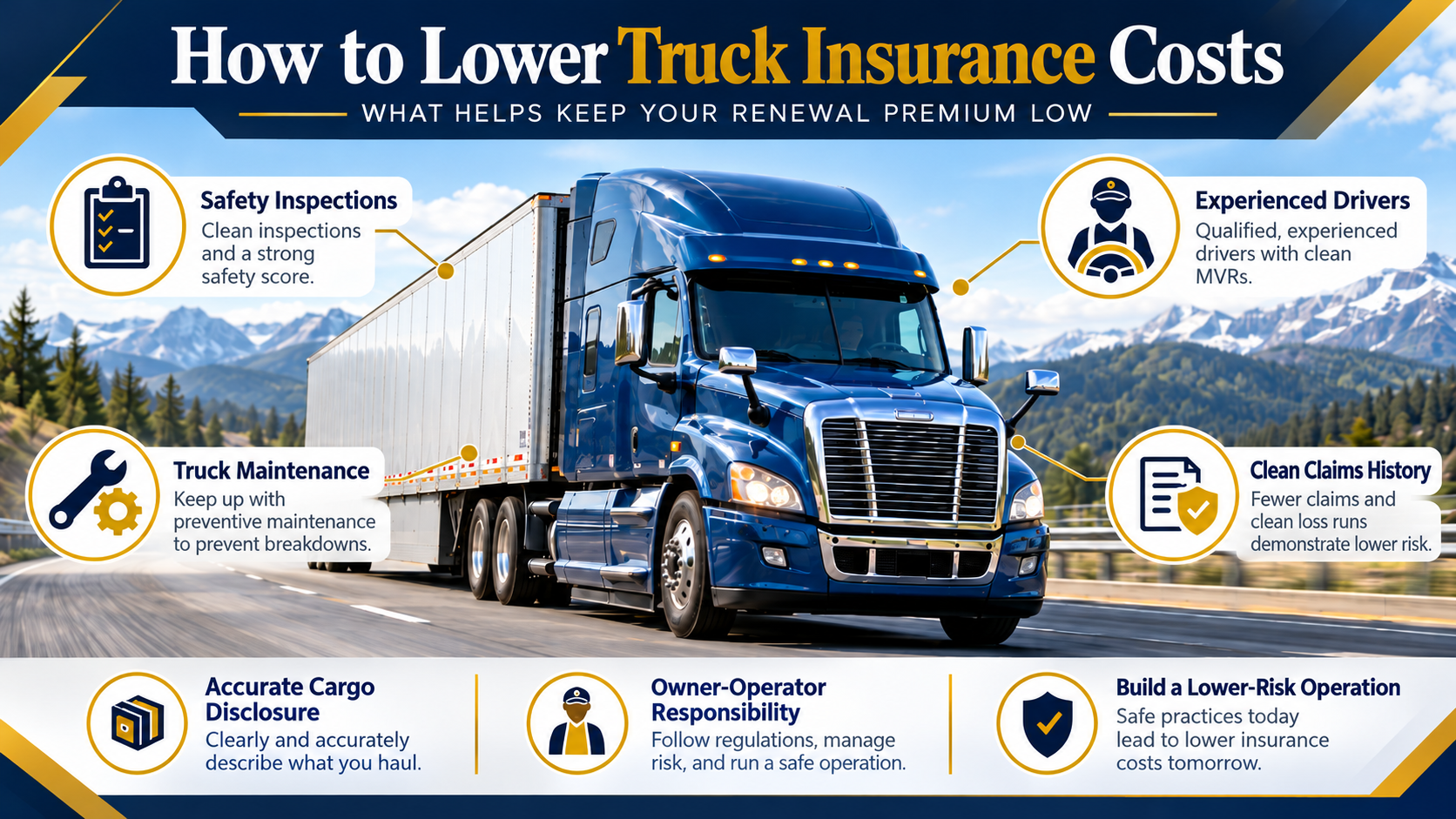
Learn how roadside inspections, driver qualifications, maintenance, loss runs, and accurate cargo descriptions can help trucking companies manage commercial truck insurance costs and renewals.
What brokers or contracts may ask for
If you own a trucking company, you already know that commercial truck insurance can be one of your biggest operating expenses. And when renewal time comes around, receiving a quote that's significantly higher than last year's premium can be frustrating.
But here's something I've learned from working with trucking companies at Quantico Insurance: getting affordable truck insurance is not just about finding an insurance company with a lower price.
It's about making your trucking business a better risk in the eyes of insurance underwriters.
I've seen trucking companies struggle to find affordable coverage because of problems that could have been prevented. I've also helped clients take corrective actions that made the difference between receiving a renewal offer and potentially losing their insurance coverage.
Let me explain what really matters when you're trying to lower your trucking insurance costs.
Why Is Commercial Truck Insurance So Expensive?
The commercial trucking insurance market has become increasingly challenging in many states, particularly Florida.
From my experience, several factors contribute to this situation, including expensive accident claims, insurance fraud concerns, litigation costs, and poor safety practices among some trucking operators.
Insurance companies are businesses that must evaluate the probability and potential cost of future claims.
When an insurance company reviews your trucking operation, it isn't simply looking at how many trucks you own or how much coverage you need.
It's evaluating the risks associated with your entire operation.
Your drivers, vehicle maintenance, roadside inspection history, previous insurance claims, and the commodities you transport can all influence the insurance company's decision.
And sometimes, those factors determine whether the insurer is willing to offer you coverage at all.
Common coverages
1. Your Roadside Inspections Can Make or Break Your Insurance Renewal
One of the first things I review when helping a trucking company obtain insurance or prepare for renewal is its roadside inspection history.
Inspections performed by DOT officers, state troopers, and officials at weigh stations can have a significant impact on how insurance companies evaluate a trucking operation.
Why Out-of-Service Violations Are So Serious
An Out-of-Service (OOS) violation means a driver or commercial vehicle has been prohibited from continuing to operate until the applicable safety issue is corrected.
These violations can result from problems involving vehicle maintenance, driver qualifications, hours-of-service compliance, or other safety requirements.
Repeated OOS violations can raise serious concerns for insurance underwriters.
The Federal Motor Carrier Safety Administration (FMCSA) uses roadside inspection and crash data as part of its Safety Measurement System (SMS), which evaluates motor carriers across several safety categories.
The system generally considers 24 months of inspection and crash performance data.
You can review this information through the FMCSA Safety Measurement System.
In my experience, a trucking company with repeated safety violations may face higher insurance premiums, fewer available insurance companies, or even difficulty obtaining a renewal offer.
A Real Case: Two Clean Inspections Helped Save a Trucking Company's Renewal
I had a client whose trucking company was dangerously close to losing its insurance renewal because of its safety inspection history.
The company had accumulated Out-of-Service violations that negatively affected its safety performance record.
The situation was serious. Without an acceptable insurance renewal, the company could have faced a disruption in its ability to continue operating.
The owner took an unusual approach.
He sought out opportunities to have his trucks inspected voluntarily by enforcement officials. This is not something state troopers normally agree to do simply because a trucking company requests it.
However, he managed to obtain two inspections.
Both inspections were completed without violations.
Those clean inspection results helped improve the company's safety performance metrics enough to move it away from the level of concern that had been affecting its renewal.
Ultimately, the insurance company agreed to offer renewal coverage.
For me, this case reinforces an important lesson:
A trucking company's inspection history is not something to ignore until renewal time.
Clean inspections can positively affect FMCSA safety measurements, although their impact depends on the company's overall record. Voluntary inspections are not guaranteed, and two clean inspections will not produce the same outcome for every company.
But maintaining safe equipment and building a better inspection record can create opportunities that might otherwise be unavailable.
2. Hiring the Wrong Driver Can Cost You Thousands in Insurance Premiums
Another major factor I evaluate is the driving history and experience of the drivers operating a company's trucks.
Many insurance companies have strict underwriting requirements regarding driver qualifications.
For example, several insurance markets I work with expect drivers to have at least two years of CDL experience.
That is an insurance underwriting preference, not a universal federal requirement for every CDL driver.
Insurance companies also review driving violations, accidents, and other indicators of driving risk.
A driver with multiple moving violations, serious accidents, or insufficient experience may make your trucking operation more expensive to insure.
In some cases, that driver can make the entire company ineligible for an otherwise competitive insurance program.
What I Recommend When a Driver Doesn't Meet Insurance Requirements
When I review a trucking company and identify a driver whose experience or driving record may create underwriting problems, I discuss the situation with the owner.
Sometimes I ask whether the company has the possibility of replacing that driver with someone who meets the insurance company's requirements.
But there's one condition I make very clear.
The replacement must be real.
You cannot simply list a qualified driver on your insurance policy to obtain a better rate while allowing an unlisted or unacceptable driver to continue operating the truck.
Misrepresenting who actually drives your trucks can create serious insurance coverage problems, including potential claim disputes.
Saving money should never involve giving an insurance company false information.
3. Poor Truck Maintenance Can Become an Insurance Problem
Some trucking companies focus on finding the lowest insurance premium while overlooking the importance of maintaining their vehicles.
That's a mistake.
Poor maintenance can lead to failed inspections, mechanical problems, Out-of-Service orders, and accidents.
Each of these situations can negatively affect your company's risk profile.
I always encourage trucking operators to take preventive maintenance seriously.
That means:
- Inspecting trucks and trailers regularly.
- Repairing mechanical defects before they become safety violations.
- Paying attention to tires, brakes, lights, and other critical components.
- Keeping accurate maintenance and repair records.
- Addressing problems discovered during roadside inspections.
- Making vehicle safety part of everyday operations.
Maintaining your trucks costs money.
But operating poorly maintained equipment can ultimately cost much more in repairs, downtime, insurance complications, and potential liability.
Mistakes that can delay a load
4. Review Your Loss Runs Before Shopping for Truck Insurance
Another important part of my review involves the trucking company's loss runs.
Loss runs are reports showing the company's insurance claims history over a specified period.
They help an insurance company understand whether the business has experienced claims and, when applicable, how frequent or severe those losses have been.
A clean loss history can be a significant advantage.
When a trucking company has operated without claims, that can help us present the business more favorably to potential insurers.
However, a clean loss history does not automatically guarantee a low premium. The insurance company will still evaluate drivers, safety performance, operations, and other underwriting factors.
I recommend reviewing your loss runs before renewal and checking that the information is accurate.
If something appears incorrect, work with your insurance agent and the appropriate insurer to resolve it.
5. Be Honest About the Commodities You Transport
The type of cargo your company transports can significantly influence your insurance options and premiums.
Some commodities present higher risks because of their value, potential for theft, exposure to damage, or other operational hazards.
This sometimes creates a temptation to describe the company's cargo differently in order to obtain a cheaper quote.
I strongly advise against that.
If your company transports certain commodities, those operations must be accurately disclosed to the insurance company.
Failing to report what you actually transport can create serious complications if you have a claim.
For example, if an insurance application represents that a company transports one type of cargo but the company regularly carries a materially different commodity, the insurer may question whether the actual operation was properly disclosed or covered.
My recommendation is simple:
Make sure your application accurately reflects your real business operations, including the commodities you transport, where you operate, and how your trucks are used.
A lower premium is not worth the risk of discovering a coverage problem after an accident.
6. Being an Owner-Operator Can Work in Your Favor
Something I've observed in the trucking insurance market is that some insurers view owner-operators favorably.
When the driver is also the owner of the trucking business, there may be a greater personal incentive to maintain the truck properly, drive carefully, avoid accidents, and protect the company's safety record.
After all, that truck is often both a significant investment and the owner's primary source of income.
From an underwriting perspective, that personal involvement can be a positive consideration for certain insurance companies.
Of course, being an owner-operator does not automatically guarantee cheaper insurance.
Driving experience, claim history, inspections, equipment, and other factors still matter.
But it's an operational detail worth discussing with your insurance agent.
How Quantico helps
7. Don't Wait Until the Last Minute to Prepare for Renewal
One of my strongest recommendations is to begin reviewing your trucking company's insurance situation well before the policy expires.
Waiting until the last few days leaves very little room to address problems that may be affecting your renewal.
90 Days Before Renewal
Start reviewing the company's overall risk profile.
- Check your roadside inspection and OOS history.
- Review your FMCSA safety performance data.
- Examine your drivers' experience and driving records.
- Request or review your insurance loss runs.
- Identify vehicle maintenance issues that require attention.
60 Days Before Renewal
Focus on correcting problems that can realistically be addressed.
- Investigate potentially inaccurate inspection records.
- Determine whether any drivers create underwriting eligibility problems.
- Complete necessary maintenance and document the repairs.
- Confirm that the insurance application accurately reflects your operations.
- Discuss possible improvements with your insurance agent.
If you believe an inspection violation was incorrectly recorded, the FMCSA provides a process called DataQs through which eligible parties can request a review.
A valid violation cannot simply be erased because it makes insurance more expensive. A request should be supported by legitimate evidence that the information is incorrect or incomplete.
30 Days Before Renewal
At this point, your agent should be working with the available insurance markets and evaluating realistic coverage options.
If your safety profile has improved, that information may help support your renewal submission.
The important thing is to give your insurance agent enough time to understand your business and present accurate, updated information to underwriters.
Not every problem can be fixed in 30, 60, or even 90 days. Some safety records remain part of the FMCSA's evaluation for longer periods.
That's why safety improvements should be continuous, not just something you do when your policy is about to expire.
8. Should You Reduce Coverage to Get Cheaper Truck Insurance?
Reducing coverage or increasing deductibles might lower your immediate insurance premium in certain situations.
But that doesn't always mean you're saving money.
Before making changes, you need to understand what your insurance actually covers and what financial exposure you would retain after an accident.
A lower premium can become an expensive mistake if your coverage is inadequate for your operations, contractual obligations, or potential losses.
I believe the goal should be to obtain the most appropriate coverage at a competitive price, rather than simply purchasing the cheapest policy available.
9. What I Look for Before Requesting Truck Insurance Quotes
When someone contacts me looking for a better trucking insurance rate, I want to understand more than just the price they're currently paying.
I review the factors that can influence whether an insurance company is willing to insure the business and under what conditions.
Some of the most important questions include:
- Does the company have a clean or problematic inspection history?
- Are there Out-of-Service violations?
- Are any recorded inspection violations potentially incorrect?
- Do the drivers meet the insurance companies' experience and driving-record requirements?
- Are the trucks being properly maintained?
- What do the company's loss runs show?
- What commodities does the business actually transport?
- Is the owner personally operating the truck?
- Has the business made meaningful safety improvements since its previous policy period?
The answers help determine which insurance markets may be appropriate and whether there are issues we should address before requesting quotes.
Sometimes the solution isn't simply to search for another insurer.
Sometimes the most effective approach is helping the trucking company improve the factors that are making it difficult or expensive to insure.
Next step
My Final Advice: The Cheapest Truck Insurance Starts With Running a Safer Business
After working with trucking companies and reviewing the challenges they face, there's one message I want every trucking business owner to understand.
You cannot control every factor that influences commercial truck insurance prices.
You cannot control the overall insurance market, the cost of major claims, litigation trends, or every insurance company's underwriting decisions.
But you can control many of the things that make your company attractive—or unattractive—to an insurance underwriter.
You can hire qualified drivers.
You can maintain your trucks properly.
You can take roadside inspections seriously.
You can monitor your safety performance and correct inaccurate information when appropriate.
You can accurately disclose your operations.
And you can make accident prevention a priority.
In my experience, the more attention trucking owners give to these issues, the better our opportunities may be to find competitive coverage and achieve more favorable renewal results.
There are no guarantees. Even a well-managed trucking company can face a premium increase.
But a strong safety record gives us a much better starting point.
At Quantico Insurance, our approach is not simply to look for the lowest price. We work to understand the trucking operation, identify underwriting concerns, and help customers explore appropriate insurance options.
If your commercial truck insurance is coming up for renewal, or you're having difficulty finding affordable coverage, contact Quantico Insurance.
A careful review of your operation today could make a meaningful difference when it's time to renew.
Let's evaluate your trucking insurance options and safety profile together. Dial (321) 407-5597.
Sources
This content is for educational purposes only and does not constitute legal, tax, or personalized insurance advice. Coverage depends on the policy, carrier, exclusions, and applicable laws. Speak with a licensed agent to review your situation.
Bilingual service